
Across different phases of my practice, certain materials return as conceptual and structural anchors. The pin is one such element — a modest, familiar object that has long been present in my work before becoming the primary material of the PIN series.
Until this recent body of work, the pin functioned as a supporting element: stabilizing, connecting, organizing, and holding components in relation. It was integral to the work’s structure, but not yet its subject.
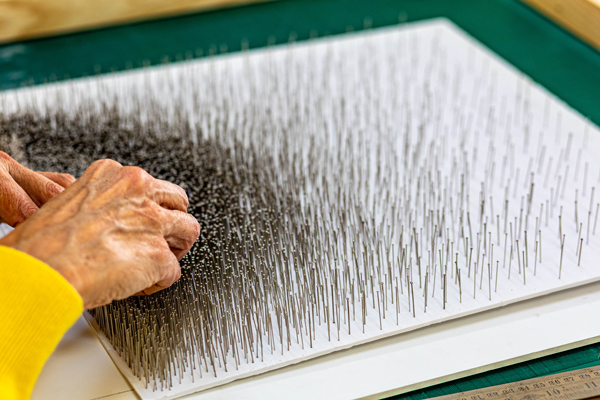
The PIN series marks a shift in which this supporting role becomes central. What once operated in the background moves into the foreground. The pin becomes protagonist, material, and language.
This development extends from earlier work in fashion, where the pin functioned as a tool of construction, adjustment, and transformation. For me, this reveals a continuity of thinking across disciplines.
From Tool to Material
In the PIN series, hundreds — sometimes thousands — of steel pins are arranged to form fields structured through variations in density, direction, and spacing.
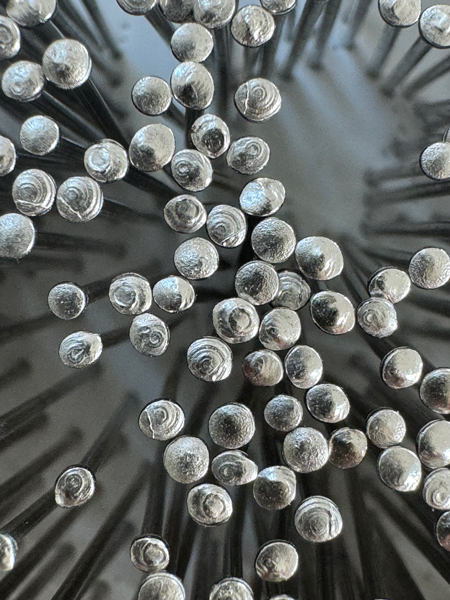
These arrangements emerge through an exploration of compression, convergence, dispersion, torsion, and extraction — translating forces into material organization. The surface becomes an active field shaped by tension, pressure, and movement.
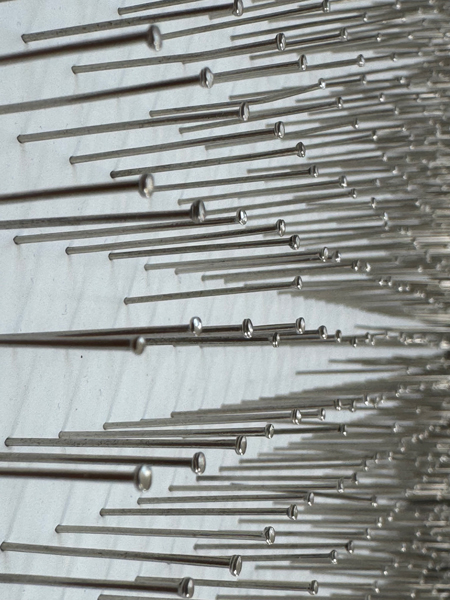
Small changes in angle, spacing, or concentration can alter the behavior of the whole. The work is built through accumulation, but experienced through variation.
Light, Rhythm and Optical Experience
Light is fundamental to how these works operate. Each pin acts as a reflective point, generating shifting optical effects that change with the viewer’s position and ambient conditions. Shadows extend and dissolve, reflected light flickers, and volumes emerge and recede.
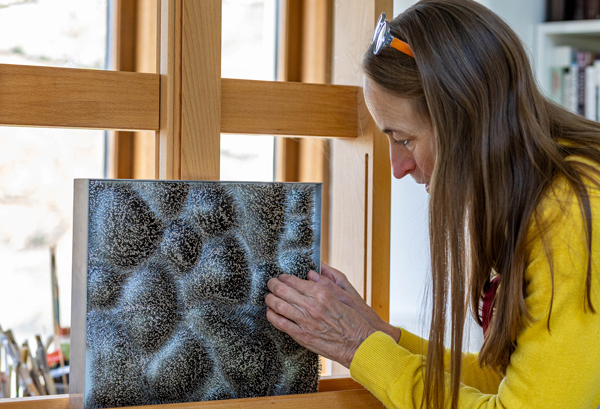
At close range, the work reveals intricate microstructures; at distance, these coalesce into broader visual fields. Density becomes a means of drawing through accumulation. Perception unfolds through movement, proximity, and time.
A Dialogue with Water
Living and working in close relation to tides, weather, swimming, boat travel, rain, mist, and snow informs the work conceptually. I am not interested in representing water literally, but in translating qualities associated with it — rhythm, instability, force, fluidity, and changing states — into structural and material terms.
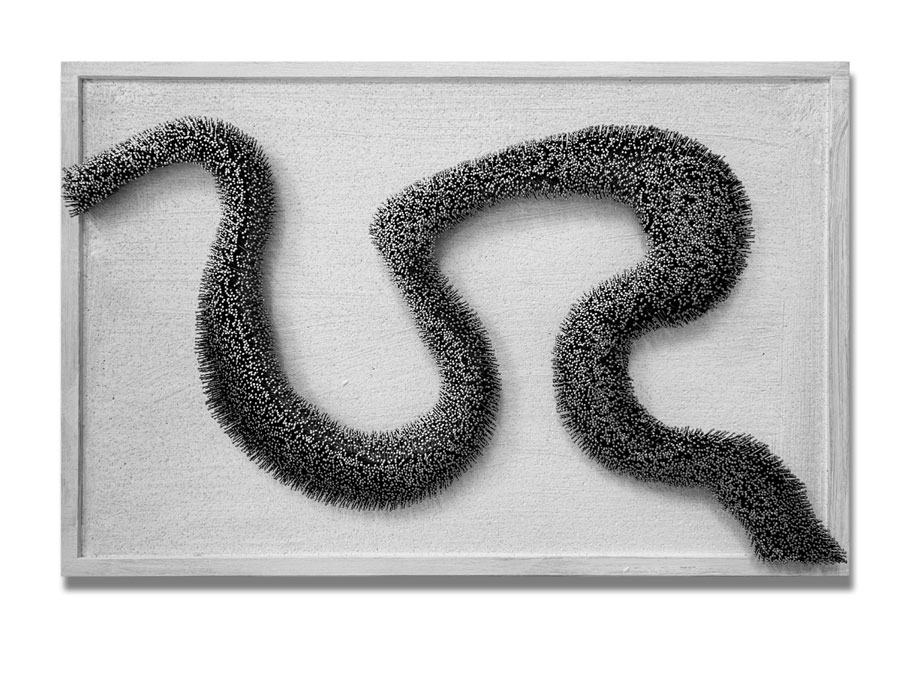
Variations in density may suggest currents; directional shifts may evoke flow; moments of compression and release may recall tidal movement. These are not representations, but structural analogies through which the work seeks to embody dynamic behavior.
Tactility, Resistance and Sound
Despite their visual precision, these works are fundamentally physical.
The process of inserting each pin is repetitive and labor-intensive, requiring force, control, and endurance. That bodily effort becomes embedded in the work as a material trace.
The work also has tactile and acoustic dimensions. Contact with the surface involves resistance, sharpness, and rhythm, while touch can generate subtle sound through the interaction of body and material.
Structure as Language
Through repetition and attention, a simple industrial object becomes a complex system of relations.
Within the PIN series, the pin shifts from support to protagonist. It operates as material, a unit of thought, and a way of translating observation into form.
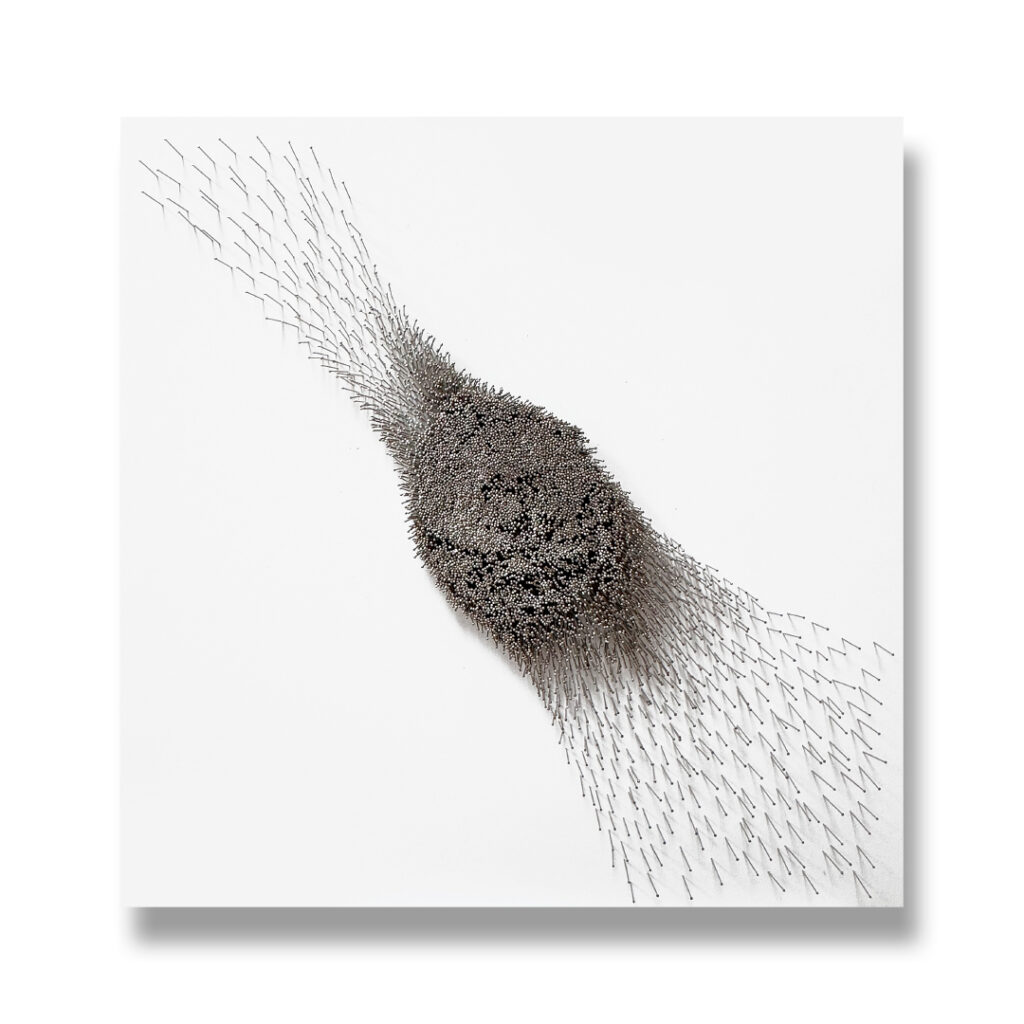
This extends earlier concerns in my practice, particularly the use of pins and their shadows as drawing in space. Here, drawing is embedded within structure through density, accumulation, light, and shadow.
Ultimately, the work proposes form not as fixed, but as contingent — shaped through forces, interdependence, and continual transformation. What once held structures together now becomes the structure through which those ideas are made visible.