
Contemporary art has long demonstrated that ordinary materials can become the basis for remarkably complex works. Pins, matches, paper, wood and other everyday objects are transformed into tools for investigating perception, structure, natural processes and spatial experience, extending their possibilities far beyond their original function.
What matters is not the material itself, but what it can reveal.
When material becomes language
An ordinary object becomes art not simply through its physical presence, but through the way it is organised, repeated and placed in relation to other elements.
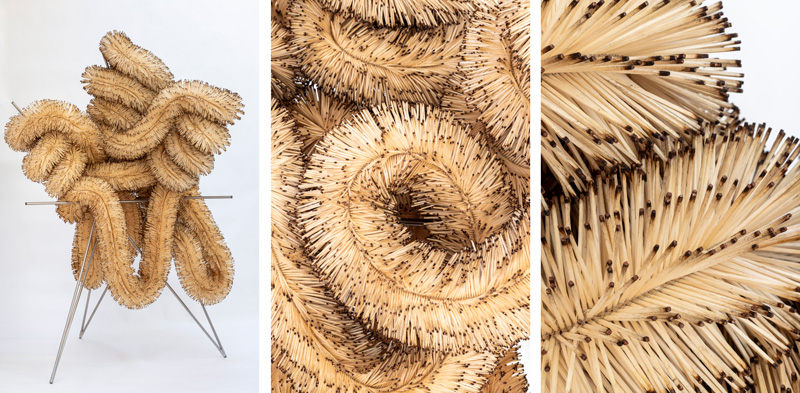
Thousands of individual elements can generate unexpected structures and rhythms. A pin ceases to be a fastening device and becomes drawing, relief and shadow. A matchstick loses its functional role and becomes architecture, tension and balance.
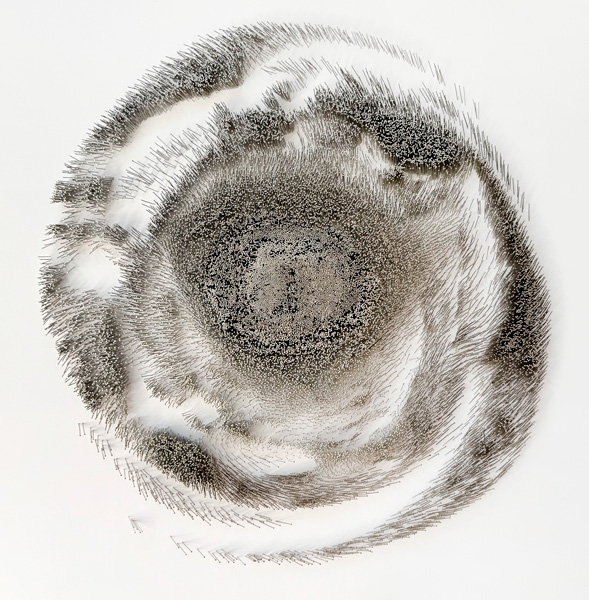
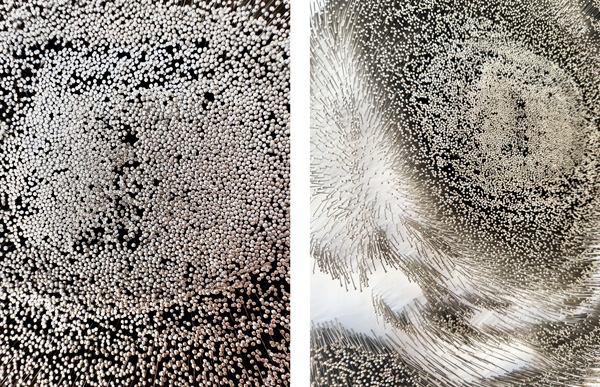
In these works, the material does not illustrate an idea. It becomes the language through which the work exists.
One investigation, many forms
Many artists pursue a single line of enquiry across different media. Rather than repeating images, they return to the same questions through different materials and forms.
This sustained enquiry lies at the heart of the work of British artist Jacqueline Duncan, whose practice grows from the observation of water and the natural processes it reveals.
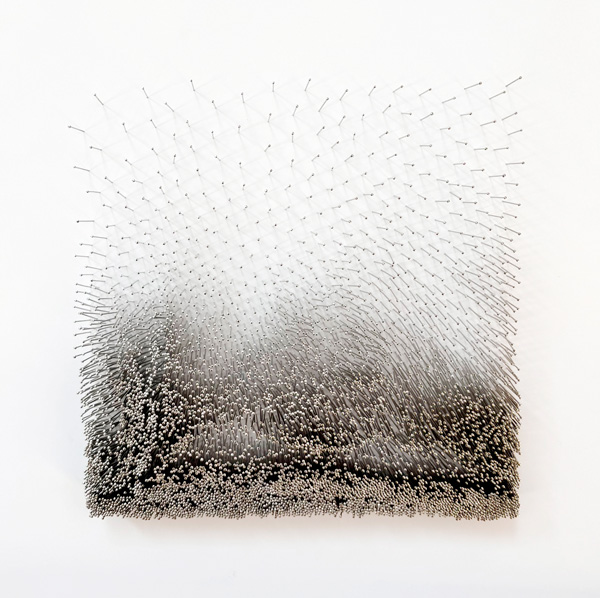
Rather than depicting water directly, Duncan investigates qualities associated with it—flow, repetition, instability, pressure and transformation. Water becomes a means of understanding the forces that shape natural systems, revealing patterns, relationships and processes that extend beyond the visible landscape.
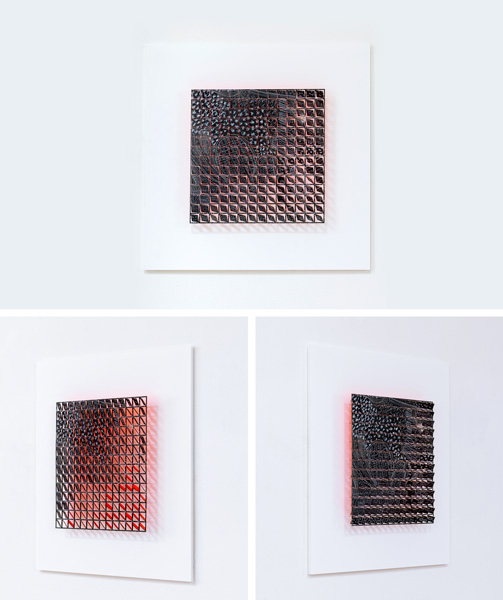
This research unfolds across abstract paintings and drawings, suspended paper constructions assembled with pins, the ongoing PIN series, and large-scale sculptures built from thousands of matchsticks.
Each material is chosen not only for its physical properties, but for its ability to embody the forces and processes observed in nature.
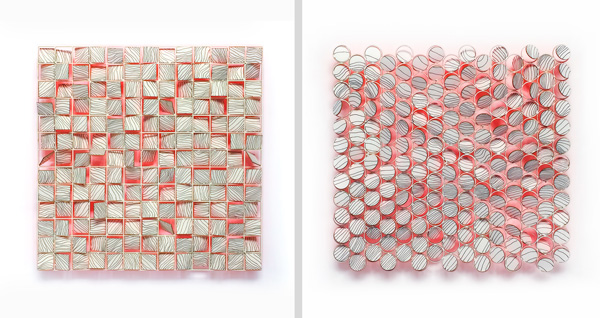
Although the materials change, the enquiry remains constant: how can invisible forces acquire physical form, and how can natural phenomena be translated into different material languages?
From observation to structure
Jacqueline Duncan lives and works on the banks of the Dart Estuary in southwest England. Tides, currents, rainfall and changing atmospheric conditions form part of her daily environment, informing a practice that explores natural forces in continual transformation and translates observation into visual structure.
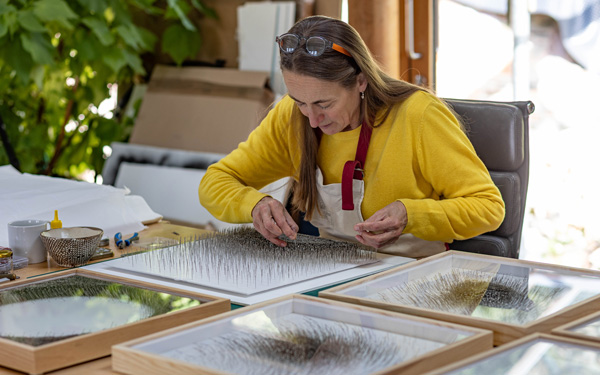
Although British, Duncan maintains a longstanding relationship with Brazil. She lived there for more than twenty years and continues to return regularly to develop projects, oversee exhibitions and maintain long-standing professional collaborations.
This ongoing dialogue between Brazil and the United Kingdom has shaped a practice that combines close observation of nature with material experimentation and spatial construction, resulting in a body of work developed with consistency over several decades.
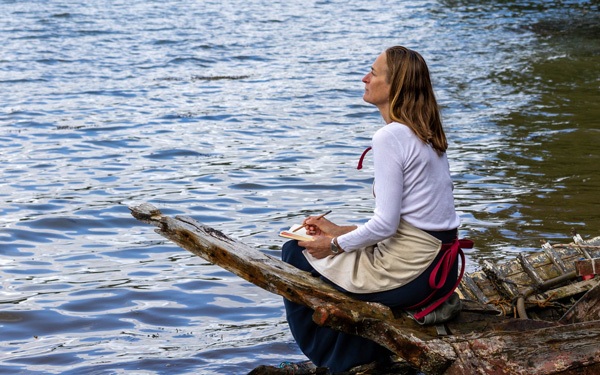
In recent years, her work has gained increasing international recognition through exhibitions selected by independent juries, including Wells Art Contemporary, VAS Biennial and The John Ruskin Prize 2026. Her exhibition history also includes the London Biennale and the Royal Academy Summer Exhibition.
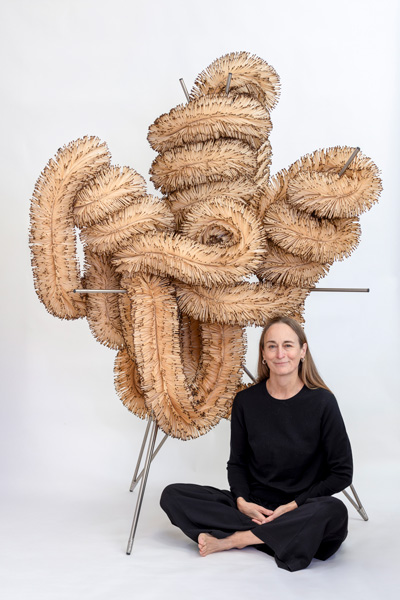
Since 2025, Duncan has been represented by Eduardo Fernandes Gallery in São Paulo. More recently, works from her PIN series were presented at SP–Arte, Latin America’s leading art fair, where they received a strong response from collectors and visitors.
Beyond materials
One of the strengths of contemporary art is its ability to show that the significance of a work lies not in the material itself, but in what that material can communicate.
A pin can speak of ocean currents. A matchstick can reveal systems of interdependence found in nature. A painting can become an experience of space.
The materials remain ordinary.
The possibilities do not.