
Painting, drawing and spatial reconstruction in my practice
Painting occupies a central place in my practice, yet it rarely remains a surface. I am interested in representation, particularly of water, and in what it means to try to get close to something like its underlying qualities through material processes, rather than depiction.
Over the years, I have developed a process that begins with painting and drawing but moves into how an image can become a physical structure. Rather than simply depicting a subject, I am interested in how a surface can gain depth and physical presence, and begin to behave in space.
Painting as flow
The process often begins with highly diluted acrylic paint on paper. Here, I allow the material a degree of freedom.
The paint spreads, accumulates, evaporates, mixes, and responds to the surface.
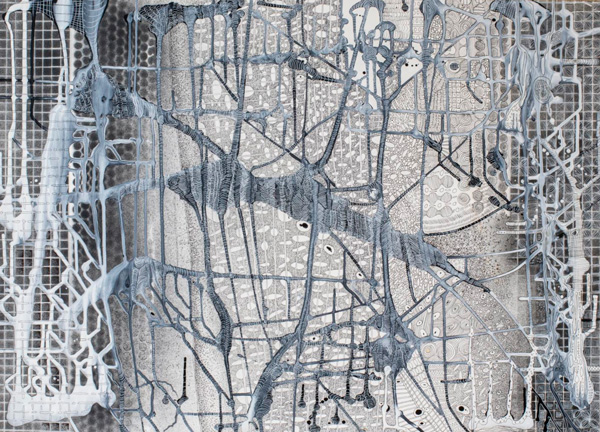
In some works, I introduce natural materials such as sand, salt, or small stones, extending the unpredictability of the process.
These early layers are not controlled towards a fixed outcome. I am interested in behaviours associated with water:
flow, dispersion, settling, turbulence, movement, change. The surface records process rather than image.
Drawing as observation
Over this fluid foundation, I develop a second layer using ink and pen. Lines, curves, patterns, waves, bubbles, and repeated structures emerge across the painted surface. Where the first stage is guided by the freer behaviour of the material, this second phase introduces observation, rhythm, and precision.
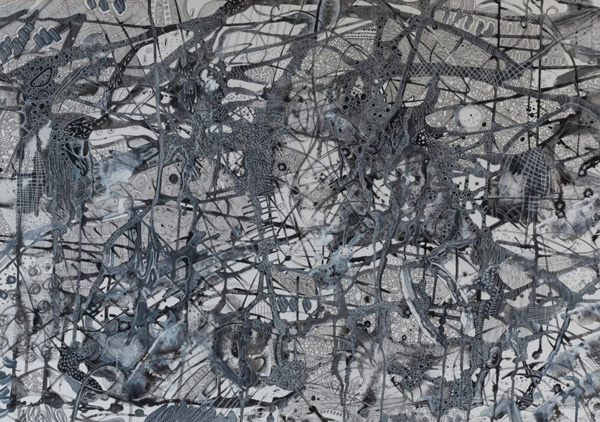
The drawings do not aim to depict water directly, but approach certain qualities of it: currents, circular movement, expansion, compression, displacement. Drawing follows and extends movements already suggested by the painting.
Fragmentation and reconstruction
In series such as Paper Assemblages and Paper Constructions, the process continues beyond the finished painting.
The surface is laser-cut — sometimes partially, sometimes in its entirety — into dozens or even hundreds of small geometric elements.
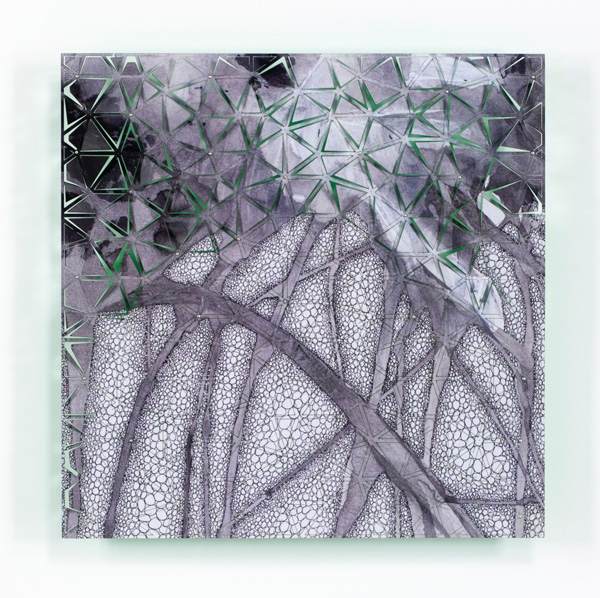
At this point, the painting is no longer a continuous image but a set of fragments.
Rather than preserving the surface intact, the work moves through interruption, separation, and displacement.
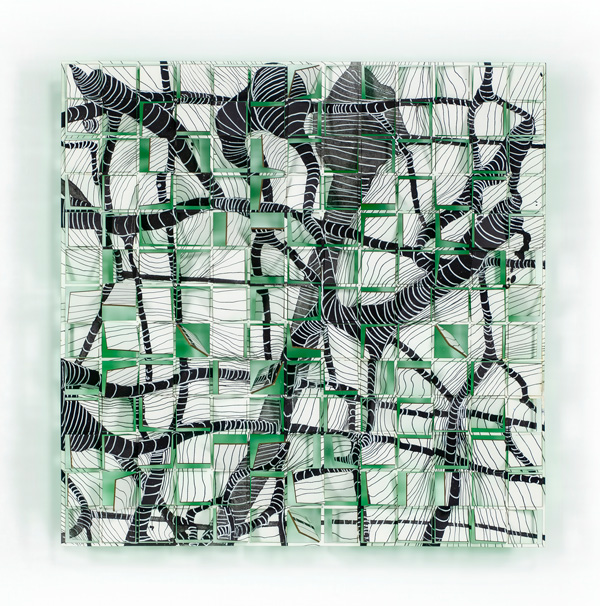
The floating image
The fragments are reorganised onto a new surface. Instead of being glued flat, each element is fixed using pins, allowing the forms to sit slightly off the support and create gaps, shadows, and shallow relief.
The fragments begin to occupy space.
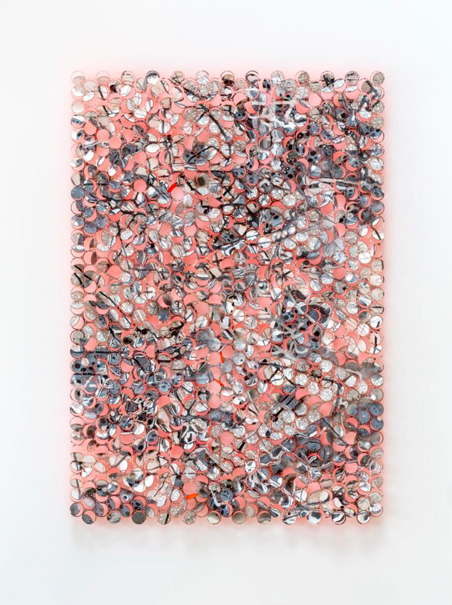
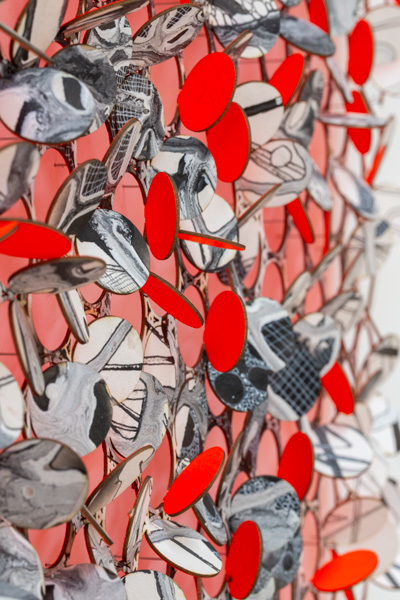
The image is no longer confined to the surface and no longer reads as a flat surface alone. At the same time, I paint additional layers that extend or echo these suspended elements. Painted shadows interact with real shadows, softening the boundary between illusion and physical presence.
From surface to structure
The work moves between painting, drawing, and sculpture.
It is rebuilt as a system of fragments, voids, shadows, shifts, and spacing.
The spaces between elements become as important as the elements themselves.
Interruption produces continuity.
Fragmentation produces structure.
The work shifts from a static surface to something that keeps rearranging in space.
Water as an underlying logic
Although the materials and processes vary, the work remains connected in part to my ongoing observation of water. I live and work beside the River Dart, in constant contact with tides, rain, mist, snow, currents, and changing weather conditions.
These experiences do not appear as literal representation, but inform how I think about movement, change, and material behaviour in the work. Like water itself, the work operates through movement and change.
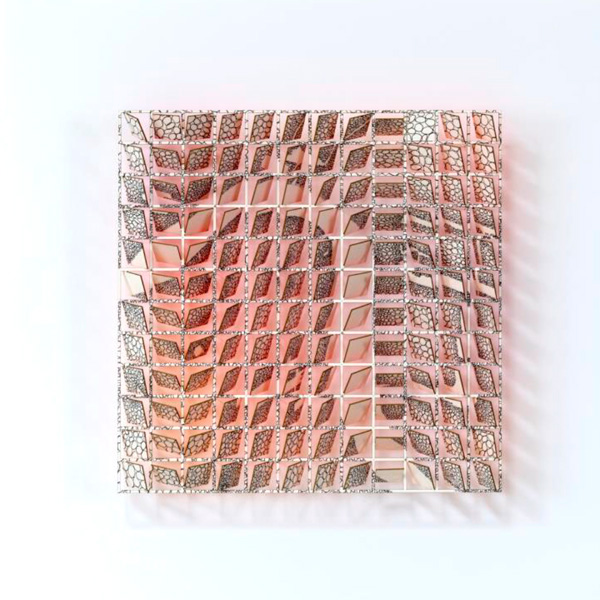
Nothing remains entirely fixed.
The image is continually reorganised.
In this sense, the work is less about representing water than about approaching it through its behaviours — translating them into structure, space, an